
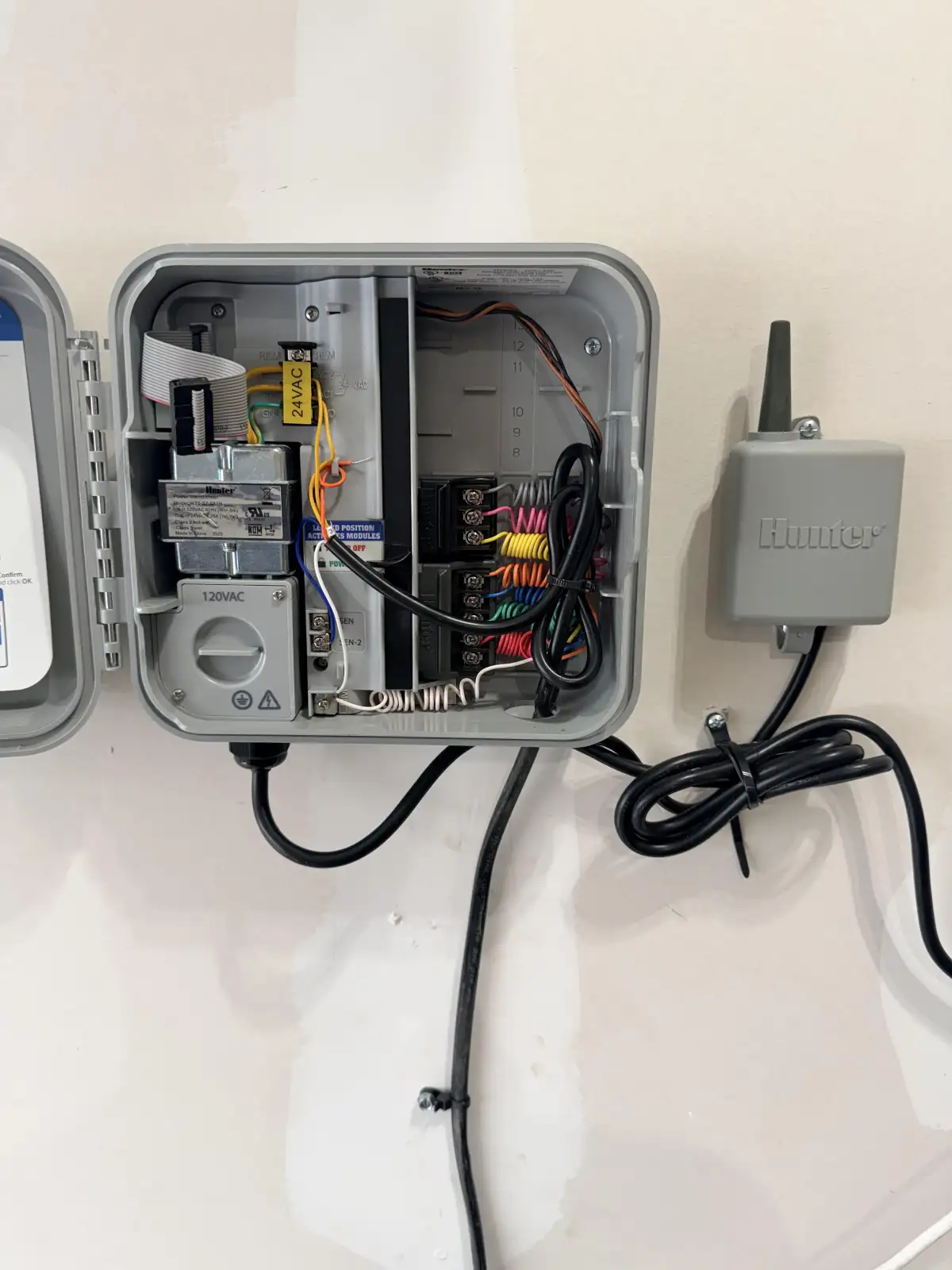
If you have had the same irrigation controller on your garage wall for ten or fifteen years, you are running your sprinkler system the same way every day regardless of whether it rained last night, whether a heat wave is coming, or whether the soil is already saturated. That is how traditional timer-based controllers work: they follow the schedule you program and never deviate from it. A smart irrigation controller replaces that fixed schedule with weather-responsive programming that adjusts automatically based on real conditions at your property.
The question most South Jersey homeowners ask is simple: is the upgrade worth the cost? The answer depends on your water source, your property size, and how much you are currently overwatering. For many households in Gloucester, Camden, and Burlington counties, the answer is a clear yes -- but there are situations where the investment does not make sense. This guide covers both sides.
What a Smart Irrigation Controller Actually Does
A smart controller is a physical device that mounts in the same location as your existing irrigation timer and connects to the same valve wiring. It does not require any changes to your sprinkler heads, pipes, or zones. The upgrade is at the brain of the system, not the body.
What makes it smart is its connection to local weather data. Instead of running a fixed schedule, a smart controller checks temperature, rainfall, humidity, wind speed, and evapotranspiration (ET) data for your specific location and adjusts each zone's run time accordingly. After a heavy rain in May, it skips the next scheduled cycle. During a July heat wave, it increases run times to compensate for faster soil drying. During a cool, overcast stretch, it reduces watering to match the lower ET rate.
The controllers we install at Irrigation Innovations are Hunter Hydrawise controllers, which pull weather data from the nearest weather station and cross-reference it with the soil type, slope, sun exposure, and plant type you configure for each zone. The result is a system that waters only when the landscape actually needs water -- not on a fixed calendar.
How Much Water Can You Actually Save?
The EPA's WaterSense program certifies smart controllers that save at least 20 percent compared to traditional timers. In real-world use, savings typically range from 20 to 40 percent depending on how poorly the previous schedule was programmed. A system that was significantly overwatering will see larger savings. A system that was already well-tuned will see modest but meaningful reductions.
For a typical South Jersey residential property using 15,000 to 25,000 gallons per month on irrigation during the summer season, a 30 percent reduction means 4,500 to 7,500 gallons less per month. On New Jersey American Water rates in Gloucester and Camden counties, that translates to roughly $200 to $600 in annual water savings depending on your usage tier and sewer surcharges.
Properties on dedicated irrigation wells will not see dollar savings on water bills (since well water is essentially free after the pump electricity cost). However, smart controllers still provide value for well-fed systems through reduced pump wear, lower electricity consumption, and healthier turf from more precise watering. If your well has a limited recovery rate, a smart controller also prevents the system from depleting the well during extended summer runs.
WiFi Controller Features That Matter
Not all smart controller features are equally useful. Here are the ones that actually make a difference for South Jersey homeowners.
Weather-Based Adjustments
This is the core feature and the primary reason to upgrade. The controller receives local weather data and modifies each zone's run time based on current and forecasted conditions. During the wet weeks in May and June when South Jersey can get two or three inches of rain in a single storm, the controller skips watering cycles that would only add to waterlogged soil. During the dry stretches in July and August, it extends run times to maintain the correct soil moisture depth.
App Control
Every major smart controller includes a smartphone app that lets you monitor and adjust the system from anywhere. This is more useful than it sounds. You can turn off the system before a landscaper visit, start a manual watering cycle for new sod or seed, check which zones ran last night, and receive alerts if the system detects a flow anomaly. For homeowners who travel during summer, app control means the system stays managed even when you are away.
Flow Monitoring
When paired with a flow sensor installed on the main irrigation supply line, the controller can detect broken pipes, stuck valves, and broken heads by comparing actual water flow against the expected flow for each zone. If zone 3 normally uses 12 gallons per minute but suddenly spikes to 20 GPM, the controller shuts down that zone and sends you an alert. This prevents a broken lateral line from running undetected for days and flooding a section of your yard.
Flow monitoring is not included with every controller and requires a separate sensor installation. For properties with large systems or a history of sprinkler system repairs, the additional cost is well worth the early leak detection.
Seasonal Adjustment Automation
Traditional controllers require manual seasonal adjustments -- increasing run times in summer, decreasing in fall, and shutting down before winterization. Most homeowners forget or do not bother, which means the system is overwatering in spring and fall and underwatering in peak summer. A smart controller handles these transitions automatically, matching water output to the actual needs of the landscape throughout the growing season.
What It Costs to Upgrade
A professional smart controller upgrade in South Jersey typically breaks down like this:
- Controller hardware: $150 to $400 depending on the model and number of zones. A 6-zone residential unit is at the lower end. A 12-zone system with flow sensor capability is at the upper end.
- Professional installation: $150 to $300 for removing the old controller, connecting the new one to existing valve wiring, configuring the WiFi connection, and programming zone-specific settings (soil type, slope, sun exposure, plant type).
- Flow sensor (optional): $100 to $200 installed, if you want leak detection capability.
- Total typical cost: $350 to $800 installed and fully configured.
For context, this is less than a single sprinkler system repair involving a main line break. And unlike a repair that restores your system to the status quo, a controller upgrade delivers ongoing savings and improved lawn health every season going forward.
When a Smart Controller Makes the Most Sense
The upgrade delivers the strongest return in these situations:
- You are on metered municipal water. New Jersey American Water and local municipal systems charge per gallon. Every gallon saved translates directly to lower bills. The payback period is typically one to two seasons.
- Your current controller is 10+ years old. Older controllers lack features like rain delay, seasonal adjustment, and zone-specific programming. Upgrading to a smart controller is a generational leap in capability.
- You have diverse landscaping. Properties with a mix of turf, garden beds, drip zones, shaded areas, and full-sun areas benefit the most from zone-specific smart scheduling. A traditional controller applies the same adjustment factor to every zone.
- You travel during summer. Remote app control means the system adapts to weather changes and alerts you to problems even when you are not home.
- You have had unexplained high water bills. A smart controller with flow monitoring catches the leaks and stuck valves that often cause water bill spikes.
When It Might Not Be Worth It
In fairness, there are situations where the cost-benefit math is less compelling:
- You are on a well with no water cost concerns. The dollar savings are minimal since your water is effectively free. The benefits are limited to convenience and lawn health improvements.
- Your system has only 2 to 3 zones. Very small systems with uniform landscaping have less to gain from zone-specific smart scheduling. A simple rain sensor ($50 to $100 installed) may provide most of the benefit at a fraction of the cost.
- You already have a relatively modern controller. If your current controller is only a few years old and includes rain delay and seasonal adjustment, the incremental benefit of upgrading to full smart capability is smaller.
- Your WiFi does not reach the controller location. The controller can still run its last saved schedule, but live weather updates, app control, and alerts require reliable WiFi at the controller. If it is in a detached garage or pump house with a weak signal, plan to extend your network to use those connected features.
Installation and What to Expect
A smart controller upgrade is a straightforward service call that typically takes 60 to 90 minutes. The technician removes the old controller, labels and transfers the valve wiring to the new unit, connects it to your WiFi network, and programs each zone with the appropriate settings.
The programming step is where professional installation adds the most value over a DIY approach. Each zone needs to be configured with the correct soil type (sandy loam is common in the Pine Barrens and coastal areas, while clay-heavy soils are more common in Gloucester and Salem counties), sun exposure level, slope, and plant material. These inputs determine how the controller calculates evapotranspiration and water demand for each zone. Getting them wrong means the system over- or under-waters specific areas despite having smart capability.
After installation, you will receive a walkthrough of the app, including how to run manual cycles, adjust schedules, check watering history, and respond to alerts. Most homeowners are fully comfortable managing their system through the app within a week.
The Bottom Line
A smart irrigation controller is not a luxury item for South Jersey homeowners on metered water. It is a practical upgrade that typically pays for itself within two seasons through reduced water usage, catches problems that would otherwise require expensive sprinkler repairs, and keeps your lawn and landscaping healthier through more precise watering. If your controller is more than a decade old and you are paying for every gallon of water, the math strongly favors upgrading.
Frequently Asked Questions
How much does a smart irrigation controller cost to install in South Jersey?
A professional smart controller upgrade in South Jersey costs between $350 and $800 installed, including the controller, wiring connections, WiFi setup, and initial zone programming. The controller itself ranges from $150 to $400 depending on the model and number of zones. Compared to the $200 to $600 in annual water savings most homeowners see, the upgrade typically pays for itself within one to two irrigation seasons.
Will a smart controller work with my existing sprinkler system?
In almost all cases, yes. Smart controllers are a direct replacement for your existing controller and use the same wiring to your valves. The upgrade requires no changes to your sprinkler heads, pipes, valves, or zones. If your existing system uses standard 24V AC solenoid valves, which covers the vast majority of residential systems installed in the last 30 years, a smart controller will work as a drop-in replacement.
Do smart controllers need WiFi to work?
Smart controllers need WiFi for connected features such as live weather-based adjustments, remote app control, and alerts. If WiFi goes down, the controller can continue running its last saved schedule, and most models can still be operated at the unit. Restoring WiFi is necessary to resume live weather updates, app access, and alerts.
How much water can a smart irrigation controller save?
EPA WaterSense-certified smart controllers save an average of 20 to 40 percent on outdoor water usage compared to traditional timer-based controllers. For a typical South Jersey home using 15,000 to 25,000 gallons per month on irrigation during summer, that translates to 3,000 to 10,000 gallons in monthly savings. On a metered water supply, the dollar savings range from $200 to $600 per year depending on your water rates and property size.